Wednesday, August 20, 2008

Merdeka, Merdeka, Merdeka!

Merdeka is a word pregnant with meaning for Indonesian people. Its translation is freedom. This three-fold idiom is shouted on this day as a powerful poetic reminder of the cries of its people, who declared their independence on the 17th August, 1945. It wasn’t until 1949, however, that the Dutch finally accepted this declaration and gave Indonesia freedom through independence.
Hari Kemerdekaan translates as Independence Day. Thus, in the Indonesian language, independence is understood as an expression of freedom.
This year Hari Kemerdekaan fell on a Sunday, thus a public holiday was given on the following Monday. On this day, Bridge of Hope, in collaboration with the local leaders organized a day of games and activities for the people of Sumompo.
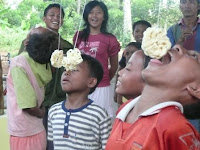
The games included a marble and spoon race (a creative rendering of Egg and Spoon conducive to a culture of excess!), a sack race (using bags used for collecting rubbish!), prawn crackers on a string (similar to doughnuts on a string), pen into a bottle (an hilarious game where the pen is dangling from a string behind the person who has to squat like going to the toilet to fit the pen into the bottle!), and finally Panjat Pinang.
Panjat Pinang is the highlight of the day, and the only game uniquely Indonesian. Here a Pinang tree is stripped of its branches and glazed with grease from bottom to top. At the top is a collection of prizes. Providing for both young and old there was provided a shorter banana (pisang) tree for the children. The children were to go first on their Pisang tree.
Around 20 eager boys stripped themselves of their shirts and lined up to reach their prize. The first few boys tried with energy and conviction to obtain their prizes just several metres from their reach. Yet, each time they were helpless to the slipperiness of the grease. Jumping and striving, clutching and climbing, they were willing to give everything despite gaining nothing. These boys, however, prepared the way for others by gradually ridding the tree of grease. Each time, the next pair would make it a few more inches up to their goal.
After 20 minutes of enjoyment and laughter, the crowd turned its’ attention to the Pinang tree as three boisterous men climbed upon each others shoulders in a rush of unruly initiative. The crowd was uproarious as they could almost feel the pain felt by the man at the bottom supporting the weight of two men above him. After 5 minutes of intense struggle they came to a crashing end. Next came a triplet with a little more innovation. They brought tools with them! The man on the top had his friend’s shirt to soak the grease and then used dirt sagging from within his tucked shirt to further provide friction for his next intended ascent. Within a few minutes they had reached their goal. Instead of reaping all the rewards, each group is only allowed three prizes to take, and then leave the rest for the next group.
Unfortunately the boys didn‘t learn from their elders and continued to struggle in pairs to reach the top without shirt or dirt. Yet, after digging their hands into the trunk of the tree they were able to make it to the top.
Panjat Pinang is a game that teaches team-work, interdependence, sharing, and provides great entertainment for spectators. The efforts of the initial groups could be seen as failures except for the fact that they played pivotal roles in preparation for the successful groups.
This celebration of Hari Kermerdekaan was enjoyed by all, and was a tribute to the presence of Bridge of Hope and their community education resource centre. This day brought together the community of Sumompo, bridging the gap between young and old, and between those on and off the rubbish tip. It also brought together several volunteers and committed university students to unify in their efforts to support the children of this rubbish tip. Finally, all the games and activities were coordinated and run by the local leaders and youth. This ensured that this local community doesn’t become co-dependent on Bridge of Hope and instead empowered these leaders and youth to use their independence and freedom to make positive changes in their community. A pertinent question we can all ask ourselves is: what am I doing with my independence and freedom?

Tuesday, August 5, 2008

Back to School!

In the past two weeks there has been much excitement at Sengkanaung. Five children are returning to an education! The education they receive is run by the Government, but is an informal school that runs every Monday and Thursday night from 6-7pm. Pictured on their first night at this Government School from left is Meldy with Diana and Leah:

Diana has spent her life scavenging for paper and plastic on Sumompo’s rubbish dump. Now that her primary carer is quite old, Diana is an important source of income for her and her sick husband. Diana thinks she is 10, although her carer (extended aunt) says she is 12. Yet, her leathery hands and feet, and rugged face suggest she has lived well beyond her age. She has never been to school, and was thus overwhelmed with fear, shame, and excitement at her first lesson. Meldy sat beside her to take her through the alphabet. Indeed, Meldy constitutes Diana’s informal informal school. That is, she will work one on one with her in Diana’s limited time. Leah is 11 years old and only been out of school for 2 years. She is quite smart and will hope to catch up so she might be able to re-enter a mainstream education.


Pictured on right is Diana and Leah on their way home after school climbing the hill known as "Seribu tangga" or 1000 steps! It is quite a climb, and especially difficult at night.

The Government’s informal school provides a place for people of all ages to decide to go back to school, without facing the inevitable problems of not fitting in being in so much older. The idyllic images from movie Billy Madison do not measure up in reality! For example, there is a 19 year old in Packet “A” doing primary school. There are three programs called Packet A, B, and yes, C. A is for those who never finished primary school, B for those who graduated primary school and C for those who graduated junior high. Graduating Packet C is equivalent to finishing high school. By being at night it allows everyone to still work in the day. At this point, the children still work in the day, which is an incredibly tough working environment. Yet, we consider this the first step in putting them on the path to choice and opportunity.

Sunday, August 3, 2008

The Micro-Financing Revolution

The 2006 Nobel Peace Prize was awarded to Dr Muhammad Yunus along with the Grameen Bank "for their efforts to create economic and social development from below." Specifically, he has been pioneering Micro-Enterprise Development for over 30 years to those who are poor in Bangladesh. Micro-Enterprise Development (MED) also known as micro-financing and micro-credit has grown at a rapid rate in recent years. This model is now internationally recognised as one of the best ways to enable those who are poor to help themselves out of poverty.

But what exactly is MED[1]? How does it operate? I believe it is helpful to view the process of micro-financing as a revolutionary style of micro bank. This can be seen by its choice of clients and its method of operations:

1. Choice of Clients

A) The poor not the rich
In most Western contexts, banks offer loans to those who have capital and the means to repay the loan. In practice it is those who are already rich who are deemed eligible to receive substantial loans. Typical banks favour the richer people in society and help perpetuate the principle that the rich get richer. In stark contrast, MEDs focus on those with little capital. MEDs choice of clients is for those who are specifically poor and without the means to receive a loan from a typical bank. In practice, many of these people turn to local loan sharks and get trapped in never ending debts on high interest. MEDs provide a radical alternative to greedy loan collectors and open the door of opportunity to economic independence.

B) Women not men
A typical bank focuses its service towards those who already have high positions of status, power, and money to ensure the continuation of profits. Thus, in many non–Western contexts this is largely focused on the male population. In contrast, the large majority of MEDs focus their services towards women. In most MED organizations women comprise around 80-95% of the client population. MEDs provide micro-loans and training to empower women in communities where their roles are often very limited and stifling. In a revolutionary way, MEDs show a concern for those who are marginalized and powerless, and works to empower and liberate.

2. Method of Operation

In most Western contexts, banks are individually oriented. Economic rationalism and Western culture purport an individualistic mindset which honours an individual’s hard work. In practice, banks only lend money to individual clients. The downside to this is a highly competitive and selfish culture. In stark contrast, most MEDs are group oriented. MEDs require that a loan group is formed. This loan group ensures that every recipient of a micro-loan is accountable to their fellow loan recipients. Meeting each week the loan group develops a group rapport and weekly repayments of the loan. Each group has a leader and secretary so that ownership of the group comes from within and not just the supporting micro-bank. The loan group prevents abuse of the loan, whilst also encourages a collective spirit. Instead of building a competitive business, each member exists to build their business individually for the collective good. This is a wonderful counter measure to greed and the ego inherent in Western economic models.

The revolution of micro-financing is sweeping across the world. Focusing on those who are poor and often powerless, MEDs seek to empower and bridge the harsh inequalities in the world today.


[1] Micro-financing is a subset of MED focusing on the economic side of development. MED has a broader focus on community development including health and education through complementary programs.

Rising to New Heights

For many weeks now I have been trying to climb one of the three coconut trees in the backyard of my house in the suburb of Malalayang, Manado. They all stand around 15 metres tall and leave me feeling very small and insignificant. Each time I try to reach the top, I get around half way up and begin to look down. As I look down, fear takes hold of me and my knees and feet begin to shake, and my palms become sweaty. I look up and see another 8 metres are needed to reach my goal: a fresh, young coconut. I decline the challenge to continue and begin my descent.

At my house are 6 males and 5 females. One boy, Salam, is a 17 year old with leprosy. He cannot climb the trees because he has deformed feet. Another, Onald cannot because he also has a problem with his feet. The other two, are both not strong enough to climb the trees. That leaves Meldy, the only male who is able to collect our prized coconuts to enjoy and used for a variety of meals: drinking, oil for cooking and milk for yellow rice and pumpkin and rice porridge. Today, Meldy is leaving for his home in the Island of Halmahera. Thus, today I woke up with a greater sense of responsibility for climbing the three giant monoliths.

Before I began my ascent, being a man who believes that there is more to what we can see and touch, I decided to begin the day seeking spiritual insights from the Bible. The section I read were some words from Jesus who said: “I assure you that if you believe and do not doubt, you will even be able to do what I have done to this fig tree.” I could have laughed; it was as if this story was speaking to the direct challenge before me. I had to rid myself of doubts and fear and have faith I could reach the top. Instead of allowing this to strengthen me, the fear began to grip me as I thought “I can’t do this.”

I began my ascent. I reached 7 metres to the place where the footholds are a little smaller. My feet began to ache. I looked down. Fear began to rise within me. I looked up and saw the goal. I continued. Swapping my feet on a small hold I began to spiral around the trunk as I continued to climb. 10 metres, 11 metres, only 3 more to go. Getting closer my confidence grew and I began to celebrate victory. I got up to the top.

Celebrating victory I almost forgot where I was and the fact that I still had to get down! I twisted 3 coconuts and watched as they plummeted to the ground and gave off a deep thud. When I finally got to the bottom I was told by my friends that the three coconuts were already old and unable to be used for drinking and eating; only for cooking. Despite my apparent failure I chose to dwell on the fact that I made it to the top and achieved one more step in identifying more with the people of North East Indonesia.

Thursday, July 3, 2008

Personal Journey with Manly-Manado

I first got involved with Manly-Manado Community Partnership in 2005. At that time I was working as a Youth Pastor at Seaforth Baptist Church. When I heard about the vision all I could see were numerous positives. It provided the opportunity for me to connect the young people in my care with people from a different culture and context. Not only that, but it provided an opportunity to link them with other young people in the local Manly community to unite across denominations and schools, another form of primitive tribalism! Essentially, I was inspired because M-M offered something uniquely different to other charity initiatives focusing on the distribution of money to meet needs. In contrast, building authentic global and local relationships was at its core.

Through Manly-Manado I have been able to use my skills as a teacher and communicator in local schools and churches. Each week I would teach at Balgowlah Boys in lunch time for boys who wanted to do more than just live a normal life. I was constantly amazed that they would come each week and even without providing junk food as an incentive! One of the highlights was seeing 14 Bally Boys respond in a practical way by participating in the M-M walk. Together they raised over $2000! At St Paul’s Catholic College I gave a few year group presentations and was very happy to meet staff and students respond in practical ways.

Through M-M I have developed many new friendships with people in the Manly community across church and school denominations. It has increased my desire for community and a community that is active in alleviating very real problems. I have become aware of the subtle forms of poverty that exists in Manly: an excessive busyness preventing genuine community and resulting in weariness, loneliness and isolation.

On a personal level I am now equally concerned in matters big and small of global responsibility. Some people may think I’m crazy, but in Australia I will never accept a plastic bag from a shop with the knowledge that I have hundreds at home, and that they pose an environmental impact in the long term and already cause many problems in our waters. Usually I bring a green bag, so it’s often a funny sight watching me juggle $40 worth of groceries in my hands! In this example, I believe that making a decision and sticking to it is what’s important. In big matters, fair trade is important to me. I am now content to live on less. I don’t need to eat out as much, or keep buying new clothes. I would rather give money to others in real need. Beyond myself, I have been excited by the way churches have united under this vision of community partnership and begun to work together, share resources and support one another.

The decision to go to Manado was quite simple really. I have become increasingly frustrated by the harsh inequalities there are in the world and want to do something more than simply writing a cheque. I have a strong conviction that ridding inhumane inequalities present in society was something close to Jesus’ heart. He continually demonstrated this challenging the rich and powerful, and siding with the poor, uneducated and powerless. Complementing this growing conviction was the gift of a background in the Indonesian language, studying at High School and University, and the opportunity to join Ian Freestone on a trip in April 2004.

Upon meeting people face to face in their daily lives and seeing how profoundly different to mine, I was aware I had won the lottery of latitude. Consequently, I have become genuinely thankful for my life. Furthermore, I didn’t want to walk away from these very real people and live with my head in the sand in the insular peninsula. My response was not motivated by obligation, but was driven by the knowledge that with freedom there is responsibility.

Since being in Manado I have become increasingly challenged by the mobility and seemingly endless opportunities that I have, in stark contrast with the lack of mobility and opportunities for people here. Living side by side these people I am very thankful for the opportunities I have been given, and simply want to open the doors of opportunity to those who are not fortunate enough to be given them. I am constantly aware that money is not the solution, but that changing my heart is.

As I continue to live here I hope to be continually challenged and to strive towards bridging inequalities in education. I hope education in schools continues in Manly as I endeavour to write a curriculum and generate support from schools in Manado. Over time I hope that relationships will be established: school to school, church to church, council to council.

The potential for this model to be replicated is huge; imagine 50 community partnerships like this were started by 2015! This, I believe, would be a great step towards the MDGs vision for the eradication of extreme poverty by 2015. Furthermore, community partnership builds a foundation of global education and understanding to prevent ignorance, prejudice and miscommunication to cause divisions and escalating problems from this. I believe that cross-cultural education and communication is a fundamental building block for a safe and secure global community.

I believe the Manly-Manado movement offers people in Manly a unique opportunity to be involved in something to tangibly connect with people from another culture and context in a long-term effort to eradicate both the obvious forms in Manado and the subtle forms in Manly. Together, we our hearts can be transformed through cross-cultural relationship. Together with the community in Manado we can improve the quality of our lives and ensure a greater global future.

Tuesday, July 1, 2008

Sengkanaung: One in Heart

On Friday, 27 June, the 'Sengkanaung' Community Education Resource Centre was officially opened. Present were the local council leaders, staff and board of Bridge of Hope and many children and adults from the community of Sumompo. Sengkanuang is a word from the language of Sangihe, a collection of Islands to the north of Manado. The majority of the residents in Sumompo are from Sangihe, and thus the name reflects their culture and background. The word means One in Heart, which is a fitting title for the aims of this education resource centre. The name was chosen by local 13 year old student Meylan Papona, who is very excited about what this means to her. I asked Meylan two questions:

Will: “Why are you excited about Sengkanaung?”
Meylan: “I’m excited that every child has the opportunity to read. Even though they may come from far away, we are ‘one in heart’. Personally, I’m excited to extend my education as I like to read.”
Will: “What is your hope for your future?”
Meylan: “I hope to become a policewoman” (POLWAN is the term which comes from POLisi and WANita which stand for police and woman).

It has been 5 weeks since the official launch with much success to speak of. Each day around 50-60 people come to Sengkanaung to read books, play guitar, interactive games, or attend an English class run by Will. Will teaches every Tuesday, Thursday, and Friday, and is supported by Meldy Modali who is the Centre Administrator. For Meldy this opportunity is not a job. She shows an incredible commitment to the children of Sumompo. The following is a brief outline of her day:

Meldy comes to the Bridge of Hope office at 8am and stays for morning devotions until 930am. She then goes straight to the rubbish tip to connect with children and parents. After lunch she opens Sengkanaung and helps children read. Sengkanaung is due to finish when the centre closes at 530pm. However, on Monday and Thursday she sits beside the 5 children who have recently joined the Government school program offered from 6-7pm. After the class finishes, she then walks the children home, which includes climbing a steep slope named ‘1000 steps’! On the other nights there are many people who are still motivated to read, and so Meldy finishes between 630-8pm. What is more, she works Monday to Saturday! I asked Meldy 2 questions:

Will: “Why are you excited about Sengkanaung?”
Meldy: “I am excited about Sengkanaung because it gives me the opportunity to help children who are not able to go to school.”
Will: “What do you hope to achieve?”
Meldy: “I want to serve them and help them as best as I can. My mission is to love and show genuine concern to everyone at Sumompo. I see this as my calling in life.”

Sengkanuang is just one little project situated on a rubbish tip in North East Indonesia. Yet, it is one little project that gives dignity to the children and community at Sumompo with fruits that will only be fully seen in years to come. It is one little project of thousands around the world that focus on minority groups that are often marginalized and forgotten, and seeks to bridge unnecessary inequalities in our world.

Monday, June 23, 2008

Manly vs Manado in the Spice Challenge!


I have recently left the beautiful surf and sunrises of Manly for the stunning scuba diving and sunsets of Manado, North Sulawesi, Indonesia to work as an Australian Youth Ambassador for Development. This assignment is a part of the Manly-Manado Community Partnership, which aims to improve the well-being of both communities in a mutually beneficial way.

I moved to Manado in March and since then have settled into life in Manado, and teaching English primarily at the rubbish tip where partner organization Bridge of Hope has built a Community Education Resource Centre, due to be officially opened on June 27, 2008.

Manado is well-known as the spice city of Indonesia, situated besides the famous spice islands of Maluku. Settling into Manado very much concerned getting used to spices. After a few months, I was ready for the cultural challenge set forth by my colleagues. I was to challenge a colleague in a food eating contest over who could eat the most spices. It was a contest between Manly and Manado. It was to be ‘The Spice Challenge’.

Sambal is a mixture of chilies, tomatoes, onions, garlic, palm sugar, and terasi, a condiment made from pounded and fermented shrimp and small fish. The sambal was made by Operations Manager Dony Rahardja. Secretary Venny Manorek officialised proceedings by reading out the rules for the contest, so all was ready to begin.

I began at a crashing pace. Adding handfuls of sambal to rice I stuffed myself until half his bowl was finished in the first 5 minutes. Truly, in contrast, began slowly, taking a little bit of sambal, eating delicately, and then adding some plain rice. Ten minutes later, things looked different. The spice had got to my stomach, and the evidence was all over my face. I was in a hot sweat. At this point I was forced to slow down. Truly kept eating, little by little.

It looked as though the story of ‘The Tortoise and the Hare’ was coming to fruition, until in a final burst of energy, and motivated by a faceless crowd of 40 000 Manly supporters, I finished the remaining remnants of spicy sambal, and licked my fingers clean to erase any doubt of complete victory. All staff present for this spectacle were astonished, remarking that I have now been initiated as truly Manadonese! As due punishment for her defeat, Truly has to sweep and mop the office of Bridge of Hope for two weeks, and is not allowed to have her favourite drink Gohu (Papaya with a spicy and sour sauce) for three months.

When asked Dony said that one bag of chilies was used for the sambal, of which he estimated included 200 chilies. I was overwhelmed by this prospect, and thus after the event went to investigate. It turns out that on average 100? chilies are included in each bag. Thus, I ate around 50 chilies in one meal!! Who knows what the next challenge might be? Symbolic to this community partnership, I thought it might have to be ‘the Vegemite Challenge!’